

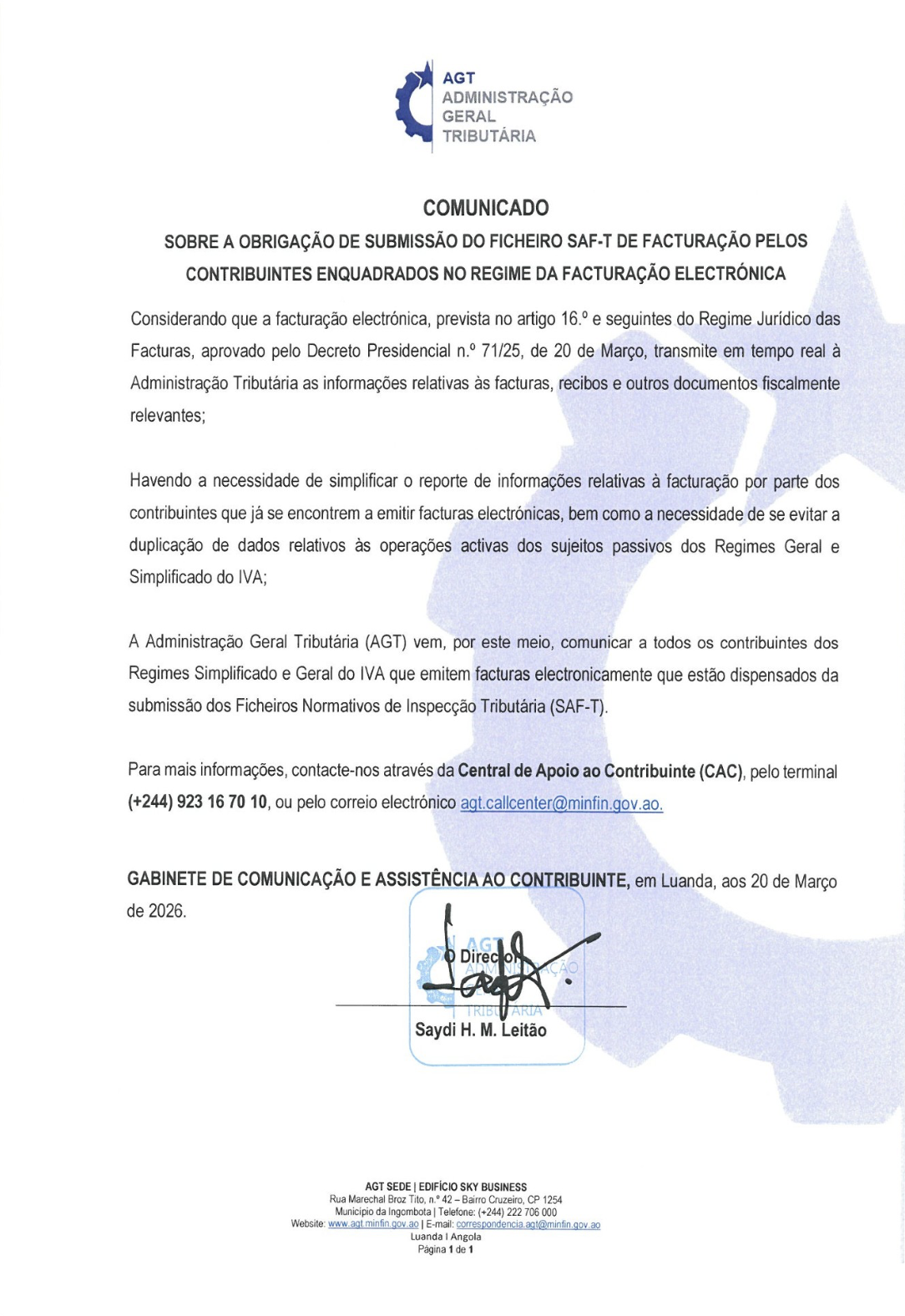
On March 20, 2026, Angola’s Administração Geral Tributária (AGT) issued an official comunicado exempting taxpayers who issue electronic invoices from the obligation to submit SAF-T files. The announcement applies to all taxpayers under the General and Simplified VAT regimes who are already operating within Angola’s e-invoicing framework.
This is a significant simplification of Angola’s digital tax compliance requirements. Until now, businesses were expected to submit both electronic invoices in real time and periodic SAF-T files, effectively reporting the same transaction data twice.
In short: If you issue electronic invoices in Angola, you no longer need to submit the invoicing SAF-T file (Ficheiro Normativo de Inspecção Tributária). The accounting SAF-T and inventory file obligations remain unchanged.
Why the AGT Made This Change
The comunicado cites three reasons for the exemption:
- •Avoiding data duplication: Electronic invoicing, as prescribed by article 16 of the Legal Regime for Invoices (Presidential Decree no. 71/25 of March 20), already transmits invoice, receipt, and other fiscally relevant data to the AGT in real time. Requiring a separate SAF-T file duplicates this information.
- •Simplifying reporting: Reducing the number of separate submissions lowers the compliance burden on taxpayers who have already invested in e-invoicing infrastructure.
- •Encouraging digitalisation: By rewarding e-invoicing adoption with fewer reporting obligations, the AGT creates an additional incentive for businesses still on paper or legacy systems to transition.
Who Is Affected
The exemption applies to taxpayers under the General and Simplified VAT regimes who issue invoices electronically. In practice, this covers:
- •Large taxpayers (annual turnover of Kz 350 million or more) who have been required to issue e-invoices since January 1, 2026.
- •Government suppliers who have been under the e-invoicing mandate since the same date.
- •All remaining taxpayers once they come under the e-invoicing mandate (Phase 2, from October 1, 2026).
Important: Taxpayers who do not yet issue electronic invoices remain subject to the full SAF-T submission requirements until they transition to e-invoicing. The accounting SAF-T (annual file due by April 10) and inventory file (due by February 15) are not affected by this exemption.
What This Means for Businesses
For businesses already on e-invoicing, the immediate impact is a reduction in compliance workload: one fewer periodic file to generate, validate, and submit. For businesses not yet on e-invoicing, this adds another reason to accelerate the transition: the compliance burden is lighter once you are inside the e-invoicing system.
From a broader perspective, Angola’s approach mirrors a pattern seen elsewhere: as real-time reporting systems mature, periodic batch-file requirements become redundant. Portugal, which shares the Lusophone SAF-T heritage, is following a similar trajectory with its own e-invoicing and SAF-T convergence.
Official Contact
For further information, the AGT’s Central de Apoio ao Contribuinte (CAC) can be reached at (+244) 923 16 70 10 or by email at agt.callcenter@minfin.gov.ao.


